Table Of Content

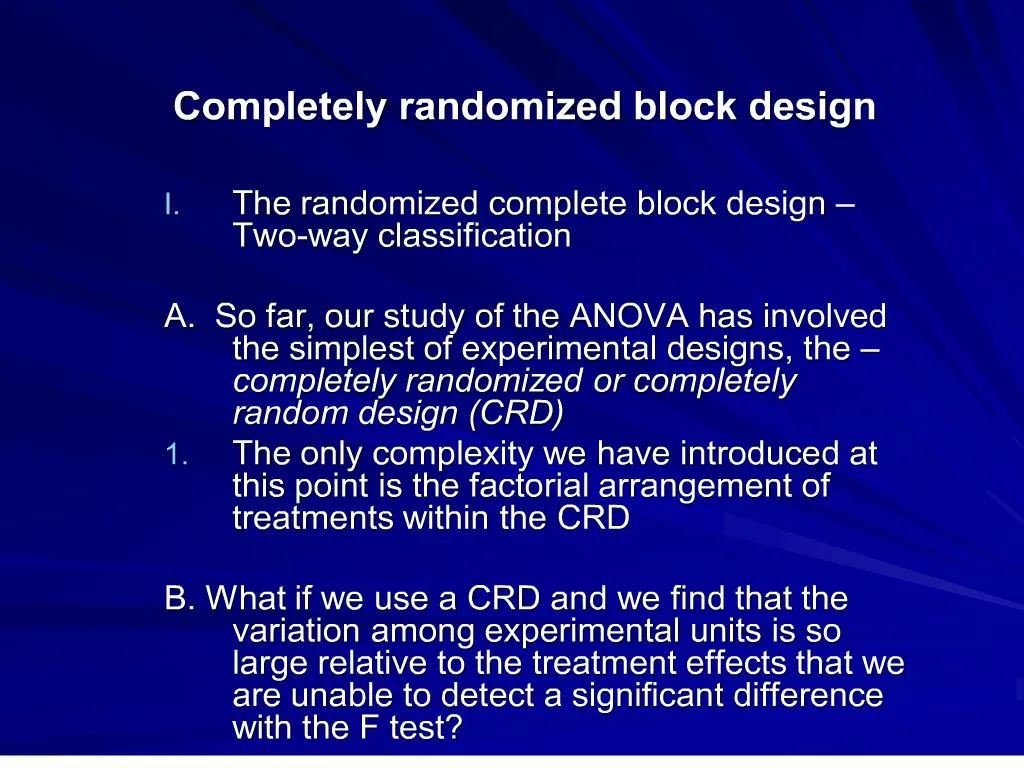
In these cases, manually reducing variability between groups by using a randomized block design will offer a gain in statistical power and precision compared to a completely randomized design. An investigator wishes to compare a family-based educational intervention for childhood weight loss with a standard individual-base program. A planned enrollment of 250 participants, 50 per study site, is to be randomly assigned to the two intervention arms. Below, a computer algorithm written in SAS® (Cary, NC) is presented for performing a block randomization with randomly selected block sizes of 4, 8 and 12 (Figure 1). The macro generates 15 randomized block allocations each for 5 study sites. A greater number of blocks are created than is necessary in the event that the investigator continues enrollment beyond the initially planned sample size.
Randomization, design and analysis for interdependency in aging research: no person or mouse is an island
The necessity to take into account blocking in the statistical analysis of the data, including when the block sizes are randomly chosen, depends on whether an intrablock correlation exists [1]. A non-zero intrablock correlation may occur, for example, when the characteristics and responses for a participant change according to their entry time into the study. If the process is homogeneous the intrablock correlation will equal zero and blocking may be ignored in the analysis. However, variance estimates must be appropriately adjusted when intrablock correlation is present [6]. The presence of missing data within blocks also can potentially complicate the validity of statistical analysis.
Explore content
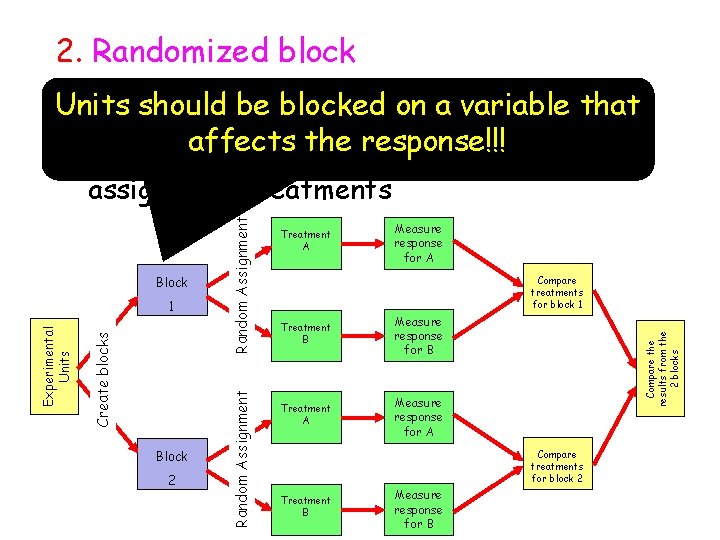
This control variable is called a blocking variable in the randomized block design. The purpose of the randomized block design is to form groups that are homogeneous on the blocking variable, and thus can be compared with each other based on the independent variable. A key advantage of blocked randomization is that treatment groups will be equal in size and will tend to be uniformly distributed by key outcome-related characteristics.
How to Carry Out a Randomized Block Design
In randomized block design, the control technique is done through the design itself. First the researchers need to identify a potential control variable that most likely has an effect on the dependent variable. Researchers will group participants who are similar on this control variable together into blocks.
The origin of randomized controlled experiments
To do this, assign physical position numbers on the bench for placing the pots. An ANOVA table provides all the information an experimenter needs to (1) test hypotheses and (2) assess the magnitude of treatment effects. People, places, species and scientific procedures have names which can be used to identify and describe a subject or a procedure. Experimental designs also have names; “Completely randomised”(CR), “Randomised block”(RB), “Latin square”, “Matched pairs” etc. These can be found in textbooks which describe the characteristics and uses of each design13.
What is a Blocking Variable?
In one example this resulted in extra power equivalent to using about 40% more animals10. The RB design is also convenient because individual blocks can be set up over a period of time to suit the investigator. Positive results will only be detected if the blocks give similar results, as assessed by statistical analysis11,12. Montgomery9,p 12 even suggests that blocking is one of the three basic principles of experimental design, along with “replication” and “randomisation”.
Understanding Random Forest. How the Algorithm Works and Why it Is… by Tony Yiu - Towards Data Science
Understanding Random Forest. How the Algorithm Works and Why it Is… by Tony Yiu.
Posted: Wed, 12 Jun 2019 07:00:00 GMT [source]
In the case of driving experience as a blocking variable, are three groups sufficient? Can we reasonably believe that seasoned drivers are more similar to each other than they are to those with intermediate or little driving experience? If the blocks aren't homogeneous, their variability will not be less than that of the entire sample. In that situation, randomized block design can decreases the statistical power and thus be worse than a simple single-factor between-subjects randomized design. Again, your best bet on finding an optimal number of blocks is from theoretical and/or empirical evidences. While it is true randomized block design could be more powerful than single-factor between-subjects randomized design, this comes with an important condition.
F Distribution Calculator
The performance and onset of sensory block times were significantly shorter in the IC group compared to the ES group. The time to first call for nalbuphine was significantly shorter in the IC group (7.31 ± 1.34 h) compared to the ES group (11.10 ± 1.82 h). The mean postoperative VAS scores were comparable between the two groups at the measured time points, except at 8 h, where it was significantly higher in the IC group, and at 12 h, where it was significantly higher in the ES group. The total nalbuphine consumption was significantly higher in the IC group (33.1 ± 10.13 mg) compared to the ES group (22.76 ± 8.62 mg). The first clinical trials were supervised by statisticians who adapted the CR design for such work. But scientists doing pre-clinical research have received little statistical support, so it is not surprising that so many of their experiments are incorrectly designed.
Significance Level
So generally, what you want is for people within each of the blocks to be similar to one another. The patient was positioned supine with a slight elevation of the head and the head turned away from the blocked side. After sterilizing the skin, the ultrasound probe was placed over the middle of the posterior border of the sternocleidomastoid muscle (Fig. 1A and B). The needle was inserted in-plane while keeping the probe in a transverse position.
For patients undergoing anterior cervical spine surgery, the intermediate cervical plexus block does not provide better postoperative regional analgesia compared to the cervical erector spinae block. Performance time and onset time were shorter in the IC group, whereas nalbuphine consumption was lower in the ES group. With the increasing number of nerve block techniques available, anesthesiologists may have difficulty determining the most appropriate technique to achieve optimal recovery after anterior cervical spine surgery. Therefore, this study was conducted to compare the analgesic effects of ultrasound-guided intermediate cervical plexus block and cervical erector spinae block in patients undergoing anterior cervical spine surgery. Regional analgesia techniques are crucial for pain management after cervical spine surgeries. Anesthesiologists strive to select the most effective and least hazardous regional analgesia technique for the cervical region.
When planning a randomized clinical trial, careful consideration must be given to how participants are selected for various arms of a study. Selection and accidental bias may occur when participants are not assigned to study groups with equal probability. A simple random allocation scheme is a process by which each participant has equal likelihood of being assigned to treatment versus referent groups. However, by chance an unequal number of individuals may be assigned to each arm of the study and thus decrease the power to detect statistically significant differences between groups. Block randomization is a commonly used technique in clinical trial design to reduce bias and achieve balance in the allocation of participants to treatment arms, especially when the sample size is small.
Our hypothesis is that an intermediate cervical plexus (IC) block can provide adequate postoperative analgesia compared to a cervical erector spinae (ES) block in patients undergoing anterior cervical spine surgery. Once the participants are placed into blocks based on the blocking variable, we would carry out the experiment to examine the effect of cell phone use (yes vs. no) on driving ability. Those in each block will be randomly assigned into either treatment conditions of the independent variable, cell phone use (yes vs. no). As we carry out the study, participants' driving ability will be assessed. We can determine whether cell phone use has an effet on driving ability after controlling for driving experience.
Designercize is a digital version of an analog whiteboard exercise originally created by Kate Rutter and Laura Klein to help designers improve whiteboarding, interviewing, and design thinking skills. It's been honed over thousands of practice sessions with Tradecraft designers. Open access funding provided by The Science, Technology & Innovation Funding Authority (STDF) in cooperation with The Egyptian Knowledge Bank (EKB). The data sets during this study are available from the corresponding author on reasonable request.


No comments:
Post a Comment